
There's Only One 'a' in 'Banana'
English pronunciation is infuriating but there's another, much more sinister reason you might not always understand what's being said. Let's talk about it!


Let’s say you studied English for a really long time. You’ve mastered the phrasal verbs, the conditionals, and the elusive Future Perfect tense. You’ve learned the correct pronunciation of words that even native people struggle with, like Worcestershire sauce and mischievous. Despite all this, you still might not know (or realize) that there’s only one /a/ sound in the word banana.
I promise you, this is not a joke. You can check a dictionary if you don’t believe me.
Here’s where you might throw your hands in the air and think, OK, I give up, this language is completely random! I wanna go home, study Classical Latin and never look back!
But Classical Latin is for cowards. You, on the other hand, are brave and curious adventurers who want to solve complex mysteries. So let’s figure this out! Why is there only one /a/ in banana?
When Vowels Chill
It’s actually quite simple. Before we begin, we have to clarify there’s not one but two important factors affecting pronunciation. The primary one is spelling. Think of cat versus take. Both words contain the letter a but the sounds it represents are completely different.
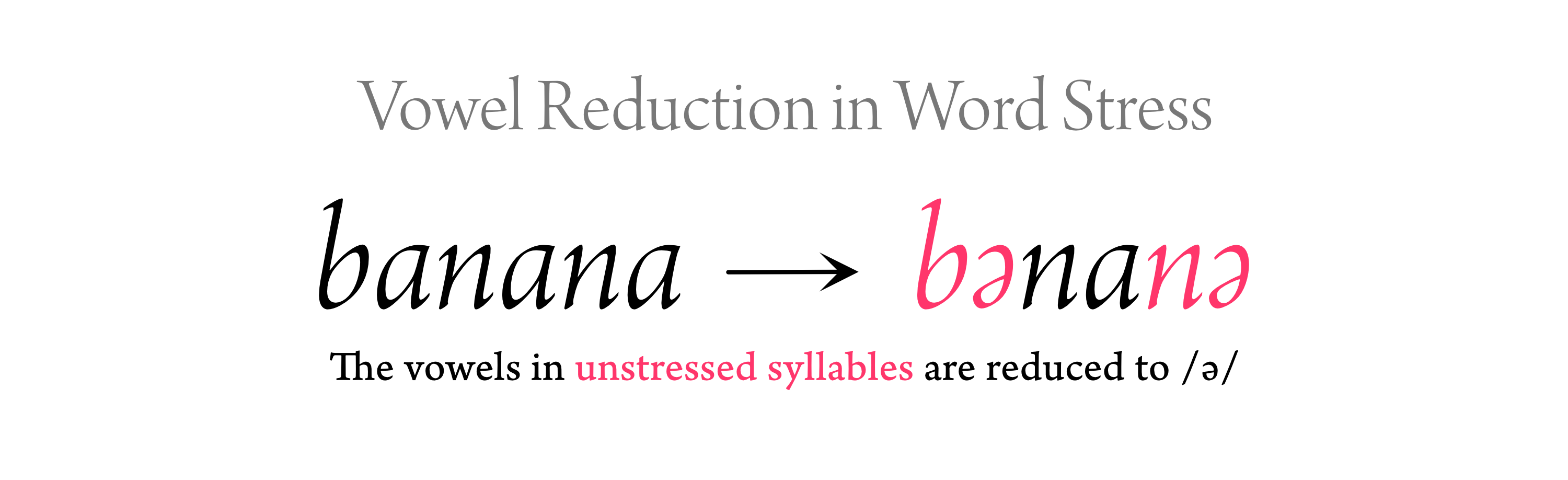
The secondary factor is word stress. English words (just like those in most European languages) usually have one prominent (stressed) syllable. In our example, the stress falls on the second syllable, where the actual /a/ is: banana.
The vowels in the unstressed syllables, on the other hand, are transformed: their /a/ sounds become /ə/. This process is called vowel reduction. and it’s one of the most consistent “rules” of English pronunciation. In fact, almost all vowels in unstressed syllables are pronounced as /ə/. Think of words like father, doctor, support, or pencil.
One More Thing
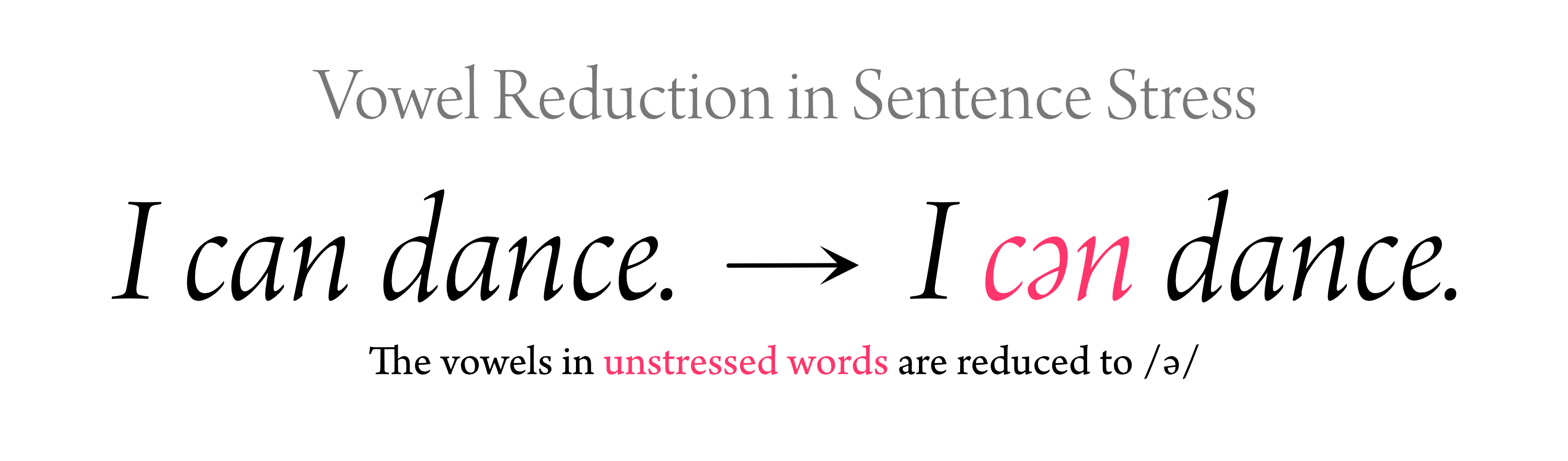
Apart from word stress, which is about emphasizing syllables, English also has sentence stress, which is about emphasizing whole words in a sentence. Whether or not a word is stressed depends on its role.
Functional words like prepositions, articles and auxiliary verbs are usually unstressed and undergo the same type of vowel reduction. The /a/ in can is reduced to /ə/.
Does This Really Matter?
Oh, yes! Mastering vowel reduction is crucial if your objective as a student is to sound native.
However, it’s important to understand that it’s not all about accent. Word stress can significantly affect the meaning of a sentence. Consider the following example:
I can help you with your studies.
If the modal can is unstressed, the sentence expresses a general ability, i.e. I have the ability to help you. If it’s stressed, it expresses reassurance, i.e. I am indeed able (and ready) to help you.
It’s pretty remarkable that such a shift in meaning is achieved just by the transformation of a single vowel, so why not take advantage of it if you can?